Stage
Multi-Day and Recharging
Hours of a router, phone charging, and a few LED lamps from the largest unit in this catalog. Notice it is not a day, and that is the argument of this whole stage: past one charge the constraint stops being capacity and becomes refilling. An estimate, not a guarantee.
What this stage covers
Everything before this stage assumes the power comes back. This one does not, and the arithmetic gets uncomfortable quickly. A large power station is a fixed number of watt-hours, and across several days the binding constraint stops being capacity and becomes the question of how anything gets refilled.
What this stage does not cover
Every stage on this site states its own limits before it states what to buy. These are the things that are still unsolved after this stage is complete.
- Refilling the unit without utility power. There are no solar panels in this catalog and this site does not estimate solar recharge or recommend panels.
- House circuits. Powering wiring from a portable source is a licensed electrician's job with a transfer switch, and this site does not cover it in any form.
- Heating a house through a cold multi-day event. That is a decision about where people sleep, not a decision about watt-hours.
- A sump pump. No stage covers it, and this one does not either: a dedicated battery backup pump installed by a licensed plumber is the answer to that problem.
- Medical or life-sustaining equipment, at this stage or any other. Plan that with the equipment supplier and your electric utility.
Do this first
Some of this costs nothing, and the free parts are the ones that get skipped.
- Work out what the household needs per day in watt-hours using the Load List Builder, then compare that against one full charge. The gap is the actual problem this stage has to solve.
- Find out where you could legitimately charge if the outage is local rather than regional: a workplace, a relative in another service area, a library, or a community center.
- Learn what your unit states about charging from a vehicle outlet, and what its manual says about doing so safely and for how long.
- Cut the load before adding capacity. Turning off the mesh nodes, the second fridge, and the router when nobody is awake is free and buys hours.
- Decide in advance at what point the household leaves. A plan made on day one is better than a decision made on day three in the cold.
What to buy at this stage
Portable Power Stations
Core job: storing watt-hours and giving them back as household AC
Because the largest units in this catalog state both the highest capacity and the highest continuous output, and at multi-day scale the difference between 1500 W and 1800 W of stated output decides what is on the table at all.
Highest stated AC output here, 1800 W
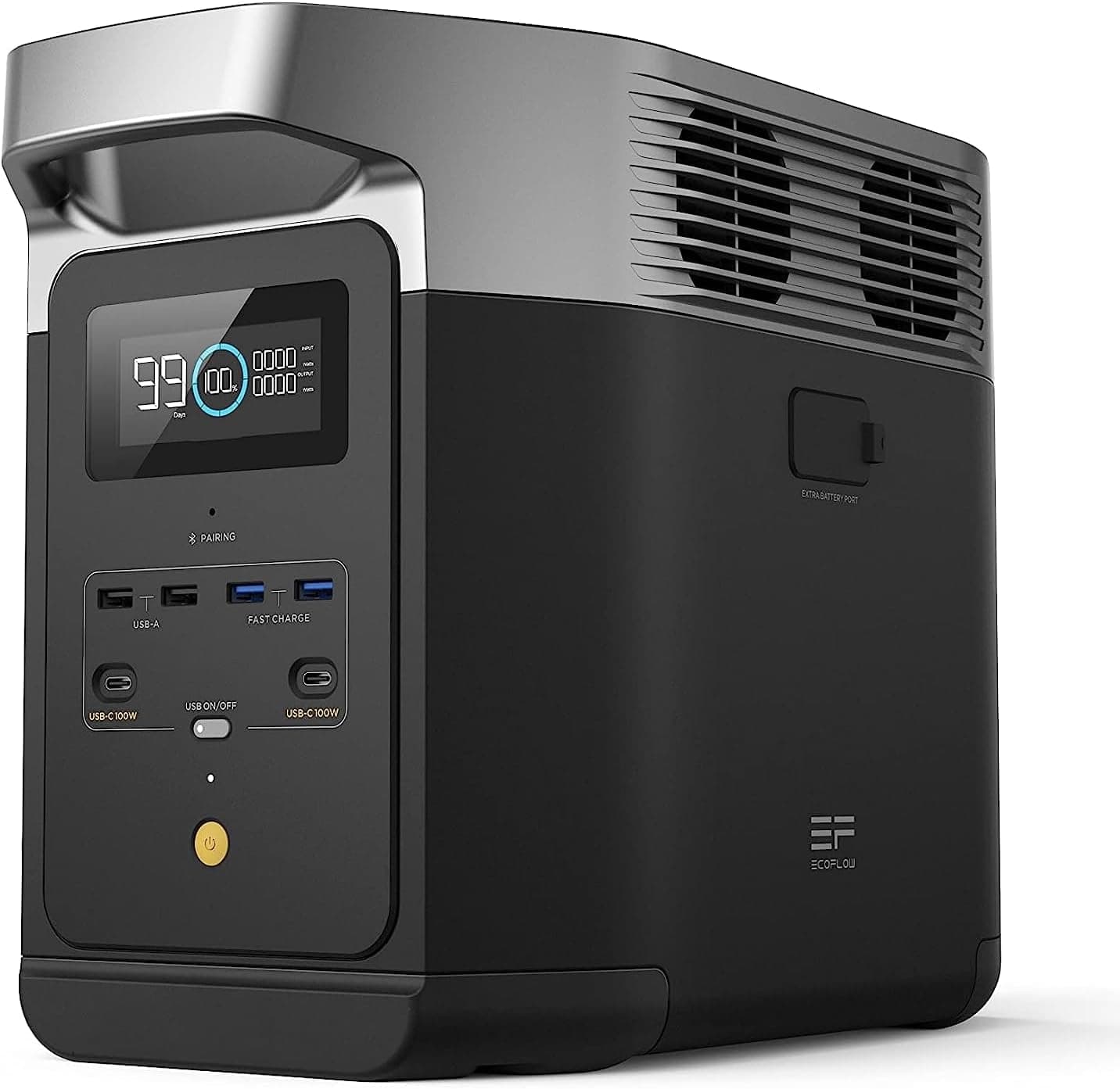
EcoFlow Delta 2 Power Station, 1024 Wh
The listing states 1024 Wh of LiFePO4 storage behind an 1800 W AC output, which is the highest continuous figure stated by any unit in this catalog. That combination is what the category is for: a large reserve of watt-hours and an inverter big enough to hand them back through a household plug. The listing states the solar panel is optional and sold separately, and no panel is included here.
- Stated capacity
- 1024 Wh
- Stated AC output
- 1800 W
- Stated USB-C output
- 100 W
- Chemistry, as the listing states
- LiFePO4
- Solar panel
- Optional and sold separately, per the listing
What it does well
- The listing states the highest continuous AC output in this catalog at 1800 W, which is what decides whether a load runs at all.
- The listing states LiFePO4 cells, the chemistry associated with longer rated cycle life on units that sit unused for years.
- The listing states a 100 W USB-C port, so laptops and phones can be charged without routing through the AC inverter.
- A stated 1024 Wh reserve is enough to put a fridge on the list of things you can consider, rather than only lights and phones.
Where it falls short
- No solar panel is included, and none is sold on this site, so the wall outlet is the only recharge path covered here.
- The listing does not state a peak or surge figure separately from the 1800 W continuous output, so motor starting headroom is unstated.
- At this capacity the unit is a two-handed carry, which limits how casually it moves between floors.
Best forThe household that has already handled lights and phones and now wants the fridge to survive a long night.
What not to buy yet
This block appears on every stage, and it is the part that separates a sequence from a catalog. Buying these things now is not dangerous; it is just out of order, and out of order is how people end up with the wrong equipment for the outage they actually get.
A solar panel
This site sells none, has no data on any, and will not recommend one it does not carry. Where a listing says solar generator, it means the unit has a solar input port and the panel is sold separately.
A fuel generator
There are none in this catalog. If you are considering one, the decision involves exhaust placement, fuel storage, and usually an electrician, and it should be made with sources that actually cover engines rather than with a site that does not.
A third battery
Past a certain point, buying more storage is a more expensive answer than reducing the load or leaving. Do the daily watt-hour arithmetic before adding capacity, because it usually argues against it.
What skipping this stage costs
There is no cost to stopping before this stage, and most households should. Skipping the earlier stages to arrive here directly is the expensive mistake: a large battery, no plan for refilling it, and none of the cheap things that handle the outages that actually happen.
The loads this stage is about
| Device | Running draw | Duty share | Average draw used | Starting surge | Est. hours |
|---|---|---|---|---|---|
| Refrigerator | 150 W | 35% | 52.5 W | Yes | 17 h |
| Chest Freezer | 100 W | 30% | 30 W | Yes | 29 h |
| Microwave | 1200 W | Continuous | 1200 W | No | 0.7 h |
| Space Heater | 1500 W | Continuous | 1500 W | No | 0.6 h |
The hours divide the average draw, not the running draw, so the duty share column is what reconciles the two: average draw is running draw multiplied by the duty share, and hours are (1024 x 0.85) divided by that average. These are estimates produced by the site formula, not guarantees, and they do not account for startup surge, temperature, or battery age.
The end of the sequence
There is no sixth stage. Past this point the useful moves are reducing what you run, arranging somewhere to go, and accepting that a portable battery is a bridge rather than a replacement for the grid.