Stage
Light and a Dead Battery
Hours of usable light across an evening and a night. This is the one figure on the site that does not come from the battery formula, because a flashlight is not a power station: it is a planning figure for a household light run on a low setting, and your light's actual runtime is in its manual.
What this stage covers
Two events account for most of what actually goes wrong in an ordinary year: the house goes dark, and the car does not start. Neither needs a power station, and both are handled here for a fraction of what one costs. This stage is where the ratio of usefulness to money is at its highest on the entire site.
What this stage does not cover
Every stage on this site states its own limits before it states what to buy. These are the things that are still unsolved after this stage is complete.
- Any device that needs a household AC outlet. Nothing bought at this stage produces one.
- The phones, once they run down. A flashlight does not charge anything.
- The refrigerator, in any form. Food decisions at this stage are about keeping the door shut.
- The router, so plan on the household internet being gone for the duration.
Do this first
Some of this costs nothing, and the free parts are the ones that get skipped.
- Put one light in each bedroom and one at the top of every staircase, tonight, before buying anything else. Placement decides whether a light is useful; specifications barely matter.
- Test every light you already own and note which ones need cells. Half of them will not work.
- Store alkaline cells outside the lights that sit unused, so a leaking cell does not ruin the light it is in.
- Check the vehicle battery's age. Most have a date on the case, and a battery well past four or five years is a scheduled failure rather than a surprise.
- Set a reminder to top up any rechargeable light or jump pack on the interval its manual gives.
What to buy at this stage
Flashlights
Core job: seeing, in the first ten seconds and the tenth hour
Because the first ten seconds of an outage and the tenth hour of one are different problems, and a light that lives plugged into the hallway wall solves the first while a light with replaceable cells solves the second.
Switches itself on when the outlet goes dead
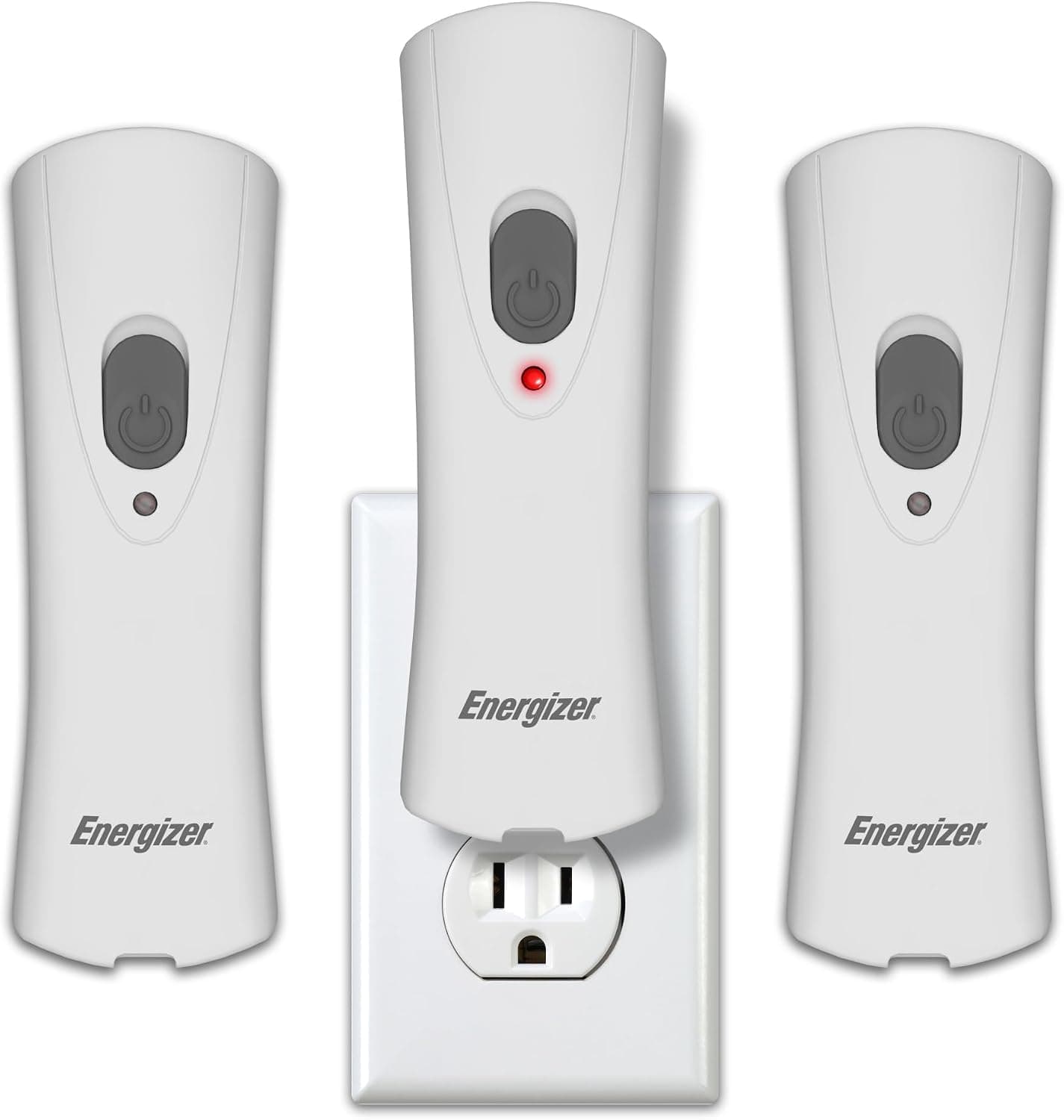
Energizer Auto-On Rechargeable Flashlights, 3-pack
These stay plugged into wall outlets, charging, and switch themselves on the moment the outlet goes dead. That solves the exact problem this category exists for: not owning a flashlight, but finding one in a room that just went black. Three in a pack covers a hallway, a stairwell, and a bedroom.
- Stated behavior
- Switches on during a power failure
- Stated power
- Plug-in rechargeable
- Quantity
- 3-pack
- Stated second use
- Night light
- Stated output
- Not stated on the listing
What it does well
- Switches itself on at the instant of the outage, so the room is never fully dark.
- Always charged, because it lives plugged into the wall rather than in a drawer.
- Three units cover the three places a household actually needs light first.
- Doubles as a night light, so it earns its outlet on ordinary nights.
Where it falls short
- Occupies a wall outlet permanently, which is a real cost in older rooms.
- The listing does not state a lumen figure, so output has to be judged in person.
- Once removed from the wall it runs on its internal charge, which is a limited reserve.
Best forThe first minute of an outage, in the hallway and at the top of the stairs, without anyone looking for anything.
Jump Starters
Core job: getting one engine started without a second car
Because a vehicle that will not start is the other common failure, it tends to arrive in the same weather, and a jump pack removes the dependency on a second car or a tow arriving in it.
Stated spark-proof and reverse polarity protection
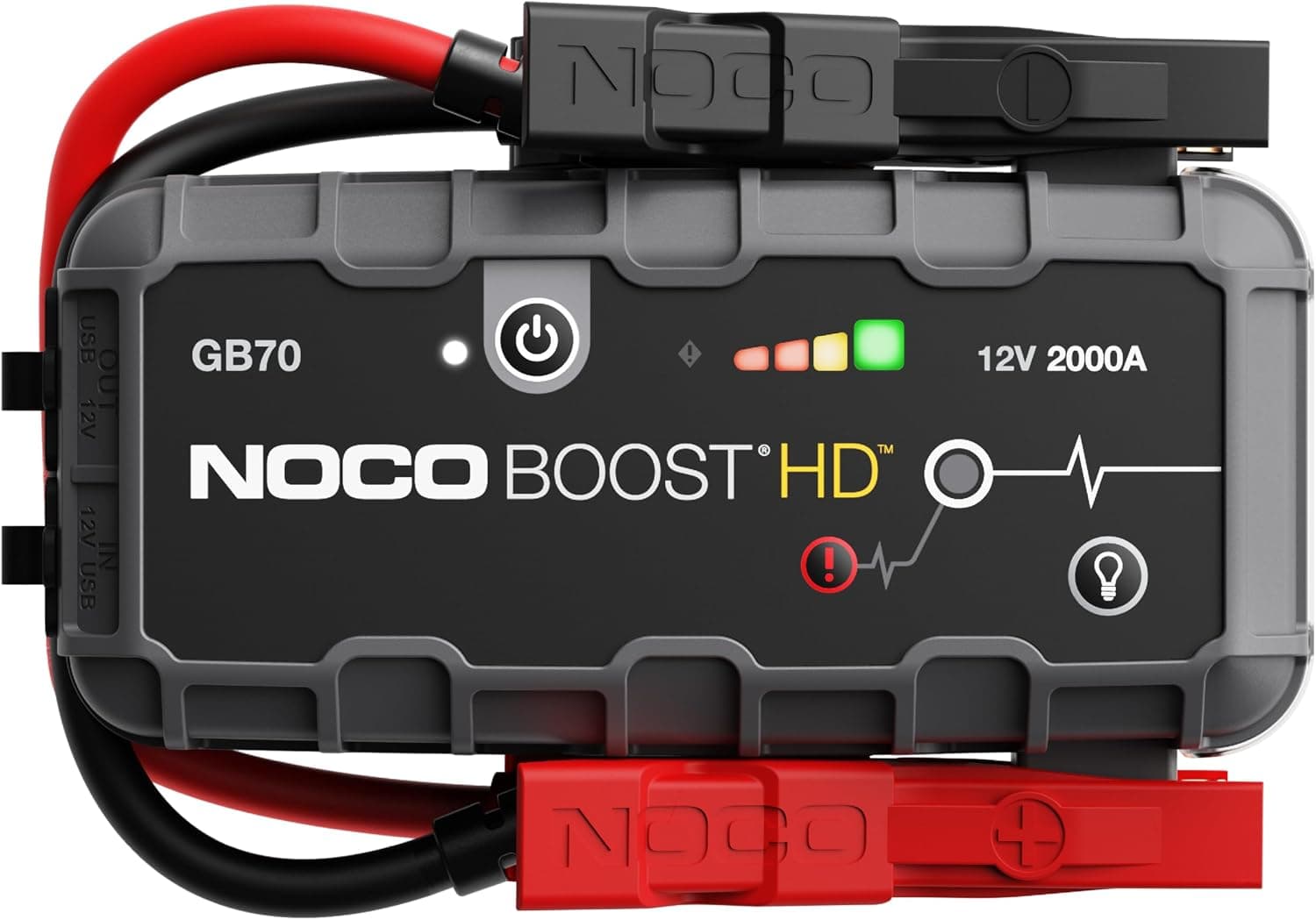
NOCO Boost GB70, 2000A
The listing states a 12 V lithium pack with spark-proof and reverse polarity protection, covering up to 8.0L gas and 6.0L diesel engines. Protection circuitry is the feature that matters most in this category, because the clamps are what a cold, hurried person gets wrong at night. The listing also states a 2000A peak figure, which this site reports and does not verify.
- Peak amps, as the listing states
- 2000A
- Stated engine range
- Up to 8.0L gas, 6.0L diesel
- Stated system voltage
- 12 V
- Stated protection
- Spark-proof, reverse polarity
- Stated pack capacity
- Not stated on the listing
What it does well
- The listing states spark-proof and reverse polarity protection, which forgives the error people actually make.
- A stated range of up to 8.0L gas and 6.0L diesel covers most passenger vehicles and light trucks.
- The stated 12 V lithium construction keeps it small enough to live in the cabin rather than the trunk.
- Well-established product line, which makes the manual and support documentation easy to find later.
Where it falls short
- The listing does not state a power bank function, so it does nothing on the days the car starts fine.
- No air compressor, so the other common reason a vehicle sits still is not covered.
- The stated 2000A peak figure is a seller claim with no published test conditions behind it.
Best forThe one jump pack in the glovebox, chosen for stated protection circuitry rather than a peak amp number.
What not to buy yet
This block appears on every stage, and it is the part that separates a sequence from a catalog. Buying these things now is not dangerous; it is just out of order, and out of order is how people end up with the wrong equipment for the outage they actually get.
A power station of any size
Nothing at this stage needs one, and buying storage before you own a flashlight is the exact inversion this site exists to argue against. Storage is the next stage and it will still be there.
The largest jump pack you can find
Peak amp claims are seller figures with no published test conditions behind them. The stated engine displacement range is what the manufacturer commits to, and it is what should decide the size.
A surge protector, yet
It is worth owning and it belongs in the next stage, alongside the small power station whose single AC outlet is the reason you will want one.
What skipping this stage costs
Skipping this stage is how a household ends up owning a thousand watt-hours of lithium and still walking into furniture. It is also how a car battery that had been failing slowly for a month becomes a problem on the one morning the roads are bad and everyone else is already calling for a tow.
The loads this stage is about
| Device | Running draw | Duty share | Average draw used | Starting surge | Est. hours |
|---|---|---|---|---|---|
| LED Lighting | 30 W | Continuous | 30 W | No | 29 h |
| Phone Charging | 12 W | Continuous | 12 W | No | 73 h |
The hours divide the average draw, not the running draw, so the duty share column is what reconciles the two: average draw is running draw multiplied by the duty share, and hours are (1024 x 0.85) divided by that average. These are estimates produced by the site formula, not guarantees, and they do not account for startup surge, temperature, or battery age.
The next stage
Finish this one before moving on. The order is the argument.